



Fast Delivery
Quick, reliable shipping to any location.

Free & easy returns
Return this item by mail or in store within 90 days for a full refund.
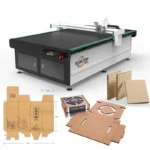
Multi-tool head flexibility — oscillating knife, creasing wheel and kiss-cut tool heads share one flatbed table so a packaging shop can switch from corrugated sample cutting to sticker contouring without adding a second machine.
Technical Specifications
| Parameter | Value |
|---|---|
| Product Type | CNC Oscillating Knife Cutting Machine |
| Working Area | 2500×1300 mm / 1600×2500 mm |
| Machine Size | 3550×1910×1400 mm / 3450×2300×1250 mm |
| Cutting Tools | Oscillating knife, creasing tool, kiss-cut knife, round punch |
| Fixing Method | Vacuum adsorption platform |
| Vacuum Pump | 7.5 kW |
| Rated Power | 9 kW |
| Cutting Thickness | Up to 18 mm |
| Repeated Accuracy | < 0.05 mm |
| Profile Format | DXF, OLT, PDF, AI |
| Transmission | Ethernet port |
| Voltage | 380 V |
| Servo Motor | Dongling / Delta servo options |
| Guide Rail | Taiwan Hiwin |
| Conveyor Belt | Germany-imported belt (optional) |
| Safety Device | Infrared sensors |
| Cutting Materials | Leather, labels, cardboard, paper, stickers, PP paper |
| Warranty | 1 year (excludes felt and knife blades) |
Application Suitability
| Application | Material or Output |
|---|---|
| Packaging carton sample making | Corrugated and honeycomb board up to 18 mm |
| Short-run carton production | Multi-layer cardboard and kraft stock |
| Sticker and label converting | Adhesive vinyl, PP paper and coated label stock |
| Paper processing | Standard office and coated graphic paper |
| Corrugated packaging | Single- and double-wall flute profiles |
Why a CNC Oscillating Knife Cutting Machine for Packaging and Carton Sample Making Fails on Thickness Alone
Cutting depth on paper is not the same as crease quality on multi-wall board.
A packaging buyer sends a single flute sample, the quotation goes out on working area, and the machine arrives underpowered for the double-wall honeycomb stock the shop actually runs most days. The blade chatters on the lower flute, the vacuum table loses grip on small carton blanks, and the crease wheel leaves a shallow line that cracks when the box is folded. I have watched packaging lines sit idle because the knife pressure and vacuum zoning were never checked against the real material stack [NEED_CITE: typical corrugated board thickness range by flute profile].
Matching Tool Heads to the Packaging Substrate
A CNC oscillating knife cutting machine for packaging and carton sample making earns its keep on tool head variety. The oscillating knife handles straight and contour cuts through corrugated and honeycomb stock, the creasing wheel scores fold lines without fracturing the top liner, and the kiss-cut knife slices the face layer of label stock while leaving the backing intact. The round punch clears internal window openings in carton blanks. Switching between these heads on a single flatbed lets a sample room move from a three-layer corrugated prototype to a sheet of contour-cut stickers in the same shift.
Vacuum Zoning and Material Hold-Down
Holding a full 2500×1300 mm sheet is straightforward; holding a nesting of small carton blanks scattered across the same table is where most vacuum systems show their limits. The aluminum alloy honeycomb adsorption platform divides into independent zones so suction concentrates where material actually sits [NEED_CITE: vacuum table zoning principles for flatbed cutters]. A 7.5 kW vacuum pump provides enough negative pressure for corrugated board, but the operator must close off unused zones or small parts will lift during high-speed oscillating passes.
Reading the Specification Sheet Beyond Working Area
Working area and cutting thickness are the first numbers a buyer checks, yet they reveal little about daily output. The repeated accuracy of less than 0.05 mm matters when a crease line must land within a millimetre of a printed registration mark. The 9 kW total rated power includes the servo drives, vacuum pump and spindle; if the workshop runs additional dust extraction on the same circuit, a dedicated breaker prevents voltage sag that can trip the servo amplifier. Ethernet transmission moves DXF, OLT, PDF and AI files directly from the design station to the machine controller without an intermediate conversion step. Taiwan Hiwin guide rails maintain linear accuracy across the full stroke, which becomes visible on long diagonal cuts where lesser rails introduce a visible wave in the edge.
The Cost of Guessing the Configuration
Choosing a smaller working area to save budget, then nesting full carton blanks at an angle to fit, introduces extra tool path length and extends sample lead time. Skipping the creasing tool in favour of scoring with the oscillating knife produces a crushed flute at the fold line, and the finished box fails the drop test. Leaving the kiss-cut head off the order means label jobs move to a separate plotter, doubling handling. These decisions surface weeks after commissioning, long enough for the original quotation conversation to be forgotten [NEED_CITE: packaging sample accuracy requirements by brand guideline].
Why Source This Cutter from the Jinan Facility
Design and production of both knife and laser cutting equipment sit under one roof, so a packaging buyer comparing knife versus laser for a mixed material list gets a single technical answer rather than two competing sales pitches. Each tool head and table size is specified against the buyer’s actual stock list before the order is confirmed. Sample cutting runs on the buyer’s own corrugated or label material, producing a physical report rather than a generic data sheet. Voltage, control language and plug type are locked in the electrical schematic before assembly begins. The factory test record documents cutting accuracy and edge quality on the agreed material stack before the machine leaves Shandong.
Documentation & Verification
- Machine specification sheet listing working area, tool head set and cutting thickness per material
- Electrical schematic with voltage and frequency confirmation matching the target market supply
- Sample cutting report produced on the buyer’s own corrugated or cardboard stock
- Software licence and file format note confirming DXF, OLT, PDF and AI import paths
- Factory test record showing repeated accuracy and crease depth before dispatch
Installation, Commissioning & Support
- Floor plan check against the 3550×1910 mm machine footprint and required service clearance
- Dedicated 380 V three-phase circuit with breaker rated for the 9 kW total draw
- Assembly of vacuum table sections and conveyor belt at the buyer’s workshop
- First-run calibration of oscillating knife pressure against the buyer’s thickest board grade
- Operator training on tool head changeover, zone valve switching and file import workflow
- Spare felt pads, replacement knife blades and creasing wheels included in the initial kit
What to Include in an Enquiry
A packaging shop evaluating a CNC oscillating knife cutting machine for packaging and carton sample making should share the thickest board grade in daily rotation, the typical nesting layout and the daily prototype count the sample room needs to produce. Confirming the local voltage and frequency, the preferred control language and the file formats already in use at the design station prevents configuration changes after the build starts. If the shop runs printed stock, providing a few sheets of the actual printed material allows a sample cut to confirm contour accuracy before the order is placed.
Frequently Asked Questions
Q: How do I choose between the oscillating knife, creasing wheel and kiss-cut tool for my packaging materials?
A: The oscillating knife cuts through corrugated, honeycomb and solid board up to 18 mm. The creasing wheel scores fold lines without crushing the flute structure, which matters for boxes that must pass a compression test. The kiss-cut knife slices only the face layer of label and sticker stock, leaving the backing intact for downstream dispensing.
Q: Should I select the compact 2500×1300 mm table or the full 1600×2500 mm format?
A: The compact table suits a sample room producing short-run prototypes and mock-ups from single sheets. The larger format accommodates full production sheets of corrugated board, reducing the number of re-load cycles during short-run carton work. Choose based on the largest sheet size your suppliers deliver, not just your current sample output.
Q: Can the machine handle printed packaging stock with contour cutting?
A: The system supports CCD camera contour recognition as an optional configuration for tracking printed registration marks. Production speed is lower on contour jobs than on blind cutting because the camera must acquire the mark between passes. Supplying a few printed sheets for a sample run confirms the mark contrast and tracking reliability before commitment.
Q: How does vacuum table zoning affect small carton parts?
A: The aluminum honeycomb platform divides into independent suction zones. When cutting a nesting of small carton blanks, the operator closes the valves on unused zones so vacuum concentrates under the material that remains. Without zoning, small parts lift during the oscillating pass and produce an unclean edge or a skipped cut.










商品评价
There are no reviews yet.