


Fast Delivery
Quick, reliable shipping to any location.

Free & easy returns
Return this item by mail or in store within 90 days for a full refund.
In-house cutting method design — knife and laser systems developed under one roof so the cutting technology matches the material, not the other way around.
Technical Specifications
| Parameter | Value |
|---|---|
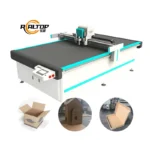
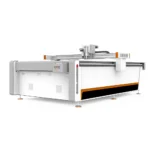
| Product Type | CNC Oscillating Knife Cutting Machine |
| Working Area | 2500×1300 mm / 1600×2500 mm (configurable by model) |
| Overall Dimensions | Up to 3550×2300×1400 mm depending on configuration |
| Rated Power | 9 kW |
| Voltage | 380V (frequency to be confirmed per target market) |
| Cutting Thickness | Up to 18 mm (basis to be confirmed by material type and density) |
| Tool Head Options | Oscillating knife, creasing tool, kiss-cut knife, round punch |
| Fixing Method | Vacuum system with aluminum alloy honeycomb table |
| Vacuum Pump | 7.5 kW |
| Repeated Accuracy | <0.05 mm |
| Transmission | Rack drive with imported straight-line square guide |
| Guide Rail | Taiwan Hiwin linear rail |
| Servo Motor | Dongling servo (Delta servo available in alternate configuration) |
| Conveyor Belt | Germany-imported belt material |
| Safety Device | Infrared sensors and emergency stop |
| File Format Support | DXF, OLT, PDF, AI |
| Data Transmission | Ethernet port |
| Software | Professional carton nesting software with customizable language |
| Blade Supply | 10 oscillating blades included |
| Warranty | 1 year (excluding felt and knife blades) |
| Delivery Time | Under 30 working days |
| Standards | CE declaration where applicable |
Application Suitability
| Application | Material or Output |
|---|---|
| Corrugated carton sample making | Single, double, and triple-wall corrugated board |
| Paper box and gift box production | Cardstock, grey board, coated paper |
| Sticker and label contour cutting | Vinyl, PP paper, adhesive-backed films |
| Advertising signage and display | Foam board, PVC sheet, magnetic sheet |
| Express packaging short-run | Lightweight corrugated and honeycomb paper |
| Business card and tag die-cutting | Thick card, laminated paper stock |
What "Cutting Thickness Up to 18 mm" Actually Depends On
The number only matters when tied to the specific board grade, flute profile, and density you run every day.
A machine quoted on working area alone often arrives at a shop that runs five-layer double-wall corrugated, and the tool pressure and oscillation frequency that worked on three-layer single-wall simply crush the flutes or leave ragged edges. I spent two days beside a carton line adjusting blade frequency and vacuum zoning one pass at a time before the cuts ran clean on double-wall stock [NEED_CITE: oscillation frequency adjustment for multi-wall corrugated]. That is why thickness ratings without material context create false expectations before the machine even leaves the factory.
Matching the Catalogue to Your Material Stack
When buyers survey the full equipment range, the first decision is whether knife cutting or laser cutting fits the material. For corrugated board, grey board, and adhesive-backed vinyl, the oscillating knife avoids the burn marks and charred edges that a CO2 beam leaves on fibrous and coated stocks. This CNC oscillating knife cutting machine manufacturer builds both knife and laser platforms in-house, so the selection starts from the material itself rather than from a single technology forced onto every job.
From Sample Table to Production Floor
A sample cutting table in a showroom runs clean on standard stock, but production floors deal with warped sheets, varying moisture content, and mixed flute profiles arriving from different board suppliers. The aluminum honeycomb vacuum table on these systems provides even suction across the full working area, and the zoning capability matters when small die-cut parts would otherwise lift at the trailing edge of the cut. Buyers moving from sample approval to daily runs need that consistency documented before the order is placed [NEED_CITE: vacuum zoning effect on small-part fixation].
Reading the Spec Sheet Beyond the Headline Numbers
The rack-and-pinion drive paired with Hiwin linear rails keeps positional drift below 0.05 mm on repeated passes, which matters when a creasing wheel follows an oscillating knife cut on the same sheet and the fold line must land exactly on the cut contour. The 7.5 kW vacuum pump is sized for the larger 1600×2500 mm table area; on the more compact 2500×1300 mm layout, the same pump holds smaller nested parts more aggressively. Servo selection between Dongling and Delta configurations affects acceleration response, which shows up most when the tool path contains many short segments typical of carton crease-and-cut jobs. File format support across DXF, OLT, PDF, and AI means the nesting software accepts artwork directly from the buyer’s existing design workflow without manual re-drawing.
The Cost of Skipping the Configuration Step
Choosing a tool head by habit rather than by material produces predictable problems: a drag knife on thick corrugated leaves crushed flutes at corners, while an oscillating knife set at the wrong frequency tears the liner paper instead of slicing it. On the vacuum side, a table without adequate zoning lets small label parts shift mid-cut, ruining entire sheets. These issues are not machine defects — they are configuration mismatches that could have been caught with a sample cutting report on the buyer’s actual stock before the machine was built [NEED_CITE: tool head and material mismatch in digital cutting].
Why Source This Range Here
The design team covers both knife and laser cutting under one engineering group, so a buyer comparing methods gets an honest recommendation instead of a push toward whichever machine is in stock. Tool head and table configuration are specified per material and daily volume, not left as a generic default. CCD camera positioning is available for printed contour work where registration marks must be tracked at production speed. Software compatibility is confirmed against the buyer’s existing file formats before the order goes to production. Sample cutting on the buyer’s own material is standard procedure, not an optional extra, so the quotation reflects tested parameters rather than catalogue claims.
Documentation & Verification
- Machine specification sheet listing every configured tool head and table zone
- Electrical schematic with voltage and frequency confirmed for destination market
- Sample cutting report run on your corrugated grade and flute profile
- Software licence and file format compatibility note before shipment
- Factory test record covering repeated accuracy and vacuum hold-down
- Packing photographs showing machine condition at dispatch
Installation, Commissioning & Support
- Floor space planning based on the 3550×2300 mm maximum footprint plus operator clearance
- Dedicated 380V circuit with confirmed Hz rating before the machine leaves the factory
- Machine arrives fully assembled on the frame; table leveling and belt tensioning done on site
- First-run parameter tuning for your specific board grade, flute type, and sheet size
- Operator training covering tool change, vacuum zoning setup, and nesting software workflow
- Ten oscillating blades supplied at delivery; felt and blade replacement cycle documented
Starting the Conversation
Share the board grades, flute profiles, and sheet sizes you run most often, along with your typical daily volume and the file formats your design team already uses. If your shop operates on a voltage or frequency outside 380V/50Hz, flag that early so the electrical package is matched before production begins. Let us know whether your artwork relies on printed registration marks so the CCD option can be evaluated against your actual print quality.
Frequently Asked Questions
Q: How do I decide between knife cutting and laser cutting for my packaging materials?
A: Knife cutting suits fibrous and layered materials like corrugated board, grey board, and foam where a laser would leave burn marks or sealed edges that interfere with folding and gluing. Laser cutting works better on acrylic, wood veneer, and certain textiles where edge sealing is an advantage. This manufacturer builds both systems, so the recommendation starts from your material, not from a single technology line.
Q: What configuration details should I confirm before placing an order?
A: Confirm the tool heads you need for your material mix — oscillating knife for cutting, creasing wheel for fold lines, kiss-cut for labels. Verify vacuum table zoning matches your smallest part size. Lock in voltage, frequency, plug type, and software language for your destination market. Request a sample cutting report on your own stock before the order enters production.
Q: When is CCD camera positioning worth adding to the system?
A: CCD positioning is needed when you cut around pre-printed graphics and must track registration marks at production speed. If your work is plain die-cut cartons or unprinted corrugated, the camera adds cost without adding value. Share a sample of your printed sheet so the recognition capability can be tested against your actual mark size and contrast before you commit.
Q: What file formats does the nesting software accept?
A: The software handles DXF, OLT, PDF, and AI files directly. Before the order is finalized, send a sample file from your current design workflow so compatibility is confirmed and any nesting or layering issues are resolved in advance, not discovered during operator training on your shop floor.
Q: How does working area size affect the machine I should choose?
A: A larger table like the 1600×2500 mm layout handles full-size corrugated sheets and supports high-volume nesting, but requires more floor space and a stronger vacuum pump to maintain hold-down. A more compact area suits sample-making and short-run carton work. Match the table to your most common sheet size and daily throughput, not to the largest sheet you might occasionally receive.










商品评价
There are no reviews yet.