


Fast Delivery
Quick, reliable shipping to any location.

Free & easy returns
Return this item by mail or in store within 90 days for a full refund.
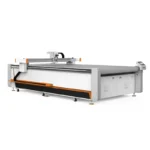
Configurable tool head matching — RT-D2516/RT-S2516 supports oscillating, drag, circular and creasing tools so the cutting method fits the cloth weight and weave instead of forcing one blade through every job.
Technical Specifications
| Parameter | Value |
|---|---|
| Product Type | CNC Oscillating Knife Cutting Machine |
| Model | RT-D2516 / RT-S2516 |
| Working Area | 1600 × 2500 mm |
| Overall Dimensions | 3450 × 2300 × 1250 mm |
| Rated Power | 9 kW |
| Voltage | 380 V ±10 % |
| Table Type | Flat working table / Auto feeding table (optional) |
| Multifunctional Head | Vibration full cut, half cut, cursor location; options include oscillating knife, pneumatic knife, high-power vibrating knife, circular knife, V-cut knife, drag knife, creasing wheel, dotted-line knife, punching, brush |
| Visual Positioning | Small CCD mark-point, panoramic camera, projection positioning (optional) |
| Translational Velocity | 800 – 2000 mm/s |
| Cutting Speed | 200 – 800 mm/s (basis to be confirmed for cloth type, thickness and layer count) |
| Repeated Accuracy | ≤ 0.1 mm |
| Transmission System | Digital servo motor, linear guide, synchronous belt, imported ball screw |
| Servo Motor Options | Delta (China) or Panasonic (Japan) |
| Instruction System | HP-GL compatible |
| Software File Formats | PLT, DXF, AI and other formats |
| Vacuum Pump | 7.5 kW |
| Vacuum Table | Magnesium-aluminium alloy, PVDF powder spray, anodic & hard oxidation, integrated air-box |
| Safety Devices | Infrared induction block, beam anti-collision, emergency stop with in-situ resume |
| Control Panel | Touch screen; English, Russian, Italian, Chinese (special languages on request) |
| Guide Rail | Taiwan Hiwin |
| Nesting Software | Auto typesetting included |
| Certification | CE (declared; verify scope for this model) |
Application Suitability
| Application | Material or Output |
|---|---|
| Single- and multi-layer garment cutting | Woven, knitted, denim, technical fabric, interlining |
| Footwear upper and lining prep | PU leather, genuine leather, mesh, textile laminates |
| Automotive interior soft trim | Suede, synthetic leather, foam-backed cloth, headliner fabric |
| Soft home furnishing panels | Upholstery cloth, blackout curtain fabric, quilted layers |
| Sports and outdoor gear | Ripstop nylon, coated polyester, TPU-laminated cloth |
| Carpet and floor mat shaping | Tufted carpet, non-woven felt, rubber-backed textiles |
What a Working-Area-Only Spec Leaves Out for a CNC Cutting Machine Manufacturer
A 1600 × 2500 mm table tells you nothing about how the blade behaves at the edge of a coated technical fabric.
I have watched garment workshops receive a machine that sailed through cotton shirting in the factory sample, only to stall on a PTFE-coated shell fabric once full production started. The oscillating frequency was too low for the abrasive coating, the blade dulled within a shift, and the entire first batch was scrapped. Selecting a CNC cutting machine manufacturer that tests on your actual cloth, not a generic swatch, removes that blind spot before the crate is nailed shut [NEED_CITE: textile cutting defect causes in coated and laminated fabrics].
Why Cloth Weight and Weave Decide the Tool Head
The RT-D2516/RT-S2516 ships with a Swiss-imported blade carrier that accepts oscillating, drag, circular and creasing tools. A 280 gsm denim runs cleanly under a high-frequency oscillating knife, while a delicate silk lining needs a drag knife at low stroke to avoid pulling threads. Swapping heads takes minutes on the tool changer, so a factory running both heavy canvas and light polyester on the same shift can stay on schedule without a second machine.
Vacuum Zoning That Keeps Small Pattern Pieces Flat
A 7.5 kW pump feeds an integrated air-box platform divided into selectable zones. When nesting children-size pattern pieces across a full 1600 × 2500 mm bed, operators activate only the zones under the active cutting path, keeping suction high where it matters. The magnesium-aluminium table surface carries a PVDF powder coat that resists adhesive residue from fusible interlinings, so zone seals stay clean over thousands of cutting cycles [NEED_CITE: vacuum hold-down best practices for flexible sheet materials].
Reading the Spec Sheet Beyond Working Area
Translational velocity reaches 2000 mm/s, but the figure that actually governs output is cutting speed, quoted here at 200 – 800 mm/s with the caveat that cloth density, layer count and blade type shift the usable number. Repeated accuracy of ≤ 0.1 mm ensures that notches and drill marks line up across successive lays, which matters when pattern pieces feed straight into automated sewing cells. The Hiwin linear guides and imported ball screws maintain that tolerance over long traverse lengths, while the digital servo — Delta or Panasonic depending on configuration — closes the position loop fast enough to follow tight corner radii on collar curves.
The Cost of Skipping a Material Trial
A buyer once specified a single-head unit for a footwear contract, assuming the quoted cutting speed applied to 3 mm EVA foam. The real speed on that density was roughly half, pushing delivery dates and forcing overtime. Another workshop found their nesting software could not import DXF files with spline curves, so operators rebuilt patterns by hand for weeks before the software vendor released a patch. Running a sample cut on the buyer’s own cloth, foam or laminate, then documenting blade choice, speed and edge quality in a written report, removes both surprises before the purchase order is signed [NEED_CITE: CNC cutting sample verification protocols].
What an In-House Design Team Changes for the Buyer
Realtop’s engineering group covers both oscillating knife and laser cutting under one roof, so a buyer surveying the catalogue can compare methods side-by-side rather than being steered toward whichever technology a single-brand dealer happens to stock. Tool head and table configurations are written into the quotation line-by-line, matched to the cloth weight and daily volume stated in the inquiry. Voltage, plug type and control-panel language are confirmed before production, and the machine is factory-tested on the buyer’s material — not a generic demo sheet — with photographs and a test record shipped in the documentation package.
Documentation & Verification
- Machine specification sheet listing every tool head option and servo brand confirmed for your order
- Electrical schematic showing 380 V ±10 % wiring, breaker sizing and dedicated circuit requirements
- Sample cutting report on your cloth weight and weave, noting blade type, stroke and edge finish
- Auto typesetting software licence key with file format compatibility note for PLT, DXF, AI
- Factory test record with dimensional check against your pattern file before crate closure
- Packing photographs of vacuum table zones, beam and control panel for transit insurance
Installation, Commissioning & Support
- Floor space of at least 4.5 × 3.5 m needed to clear the 3450 × 2300 × 1250 mm frame plus operator walkway
- Dedicated 380 V three-phase circuit with 25 A breaker for the 9 kW main drive plus 7.5 kW vacuum pump
- Split-box vacuum table halves bolt together on site; levelling feet and Hiwin rail alignment checked by installer
- First-run parameter setting covers blade stroke, vacuum zone map and CCD mark-point calibration on your pattern
- Operator training on touch-screen nesting, tool change and emergency stop resume in your chosen language
- Spare blade stock, PVDF touch-up spray and Hiwin rail grease included in the initial spare-parts kit
What to Prepare Before Requesting a Quotation
Send a data sheet or physical sample of the cloth, including weight per square metre, weave type and any coating or laminate. State the maximum lay height and the number of plies you plan to cut per shift. Confirm the voltage and frequency at your facility, the control-panel language your operators need, and whether your existing nesting workflow relies on PLT, DXF or AI files so software compatibility is verified up front.
Frequently Asked Questions
Q: How do I decide between an oscillating knife and a drag knife for my cloth?
A: Oscillating knives suit heavier woven and technical fabrics where a clean, burr-free edge is required at production speed. Drag knives work better on thin, delicate linings where vibration could pull threads. The RT-D2516/RT-S2516 accepts both heads, and a sample cut on your actual cloth confirms which gives the edge quality and throughput you need before the order is placed.
Q: Will the auto typesetting software import my existing pattern files?
A: The included nesting software reads PLT, DXF, AI and other common vector formats. Before the machine ships, your file set is tested for curve fidelity, notch accuracy and kerf compensation. If a proprietary format is involved, the software team confirms conversion or plug-in availability so your workflow continues without manual redraws.
Q: What is the real cutting speed on multi-layer cloth?
A: The quoted 200 – 800 mm/s range depends on fabric density, coating, lay height and blade type. A sample cut report on your own material stack records the actual speed, blade life and edge quality achieved, giving you a reliable baseline for daily output planning instead of a generic catalogue figure.
Q: Can I add a CCD camera later if I start cutting printed contours?
A: Yes. The RT-D2516/RT-S2516 supports small CCD mark-point, panoramic camera and projection positioning as optional modules. The mounting interface and cable routing are pre-engineered in the beam, so a camera can be added on site without structural modification, provided the control software is updated to the visual-positioning licence.
Q: Which servo motor brand should I choose for my market?
A: Delta and Panasonic servos are both available. Delta offers cost-effective performance with strong regional support in Asia, while Panasonic provides broader service coverage in Europe and the Americas. The choice depends on local spare-part availability and your maintenance team’s existing brand familiarity.










商品评价
There are no reviews yet.