




Fast Delivery
Quick, reliable shipping to any location.

Free & easy returns
Return this item by mail or in store within 90 days for a full refund.
Tool-Head Match per Material — every knife, creasing wheel and kiss-cut tool on this table is specified against your flute type and ply count before the order goes to the factory floor.
Technical Specifications
| Parameter | Value |
|---|---|
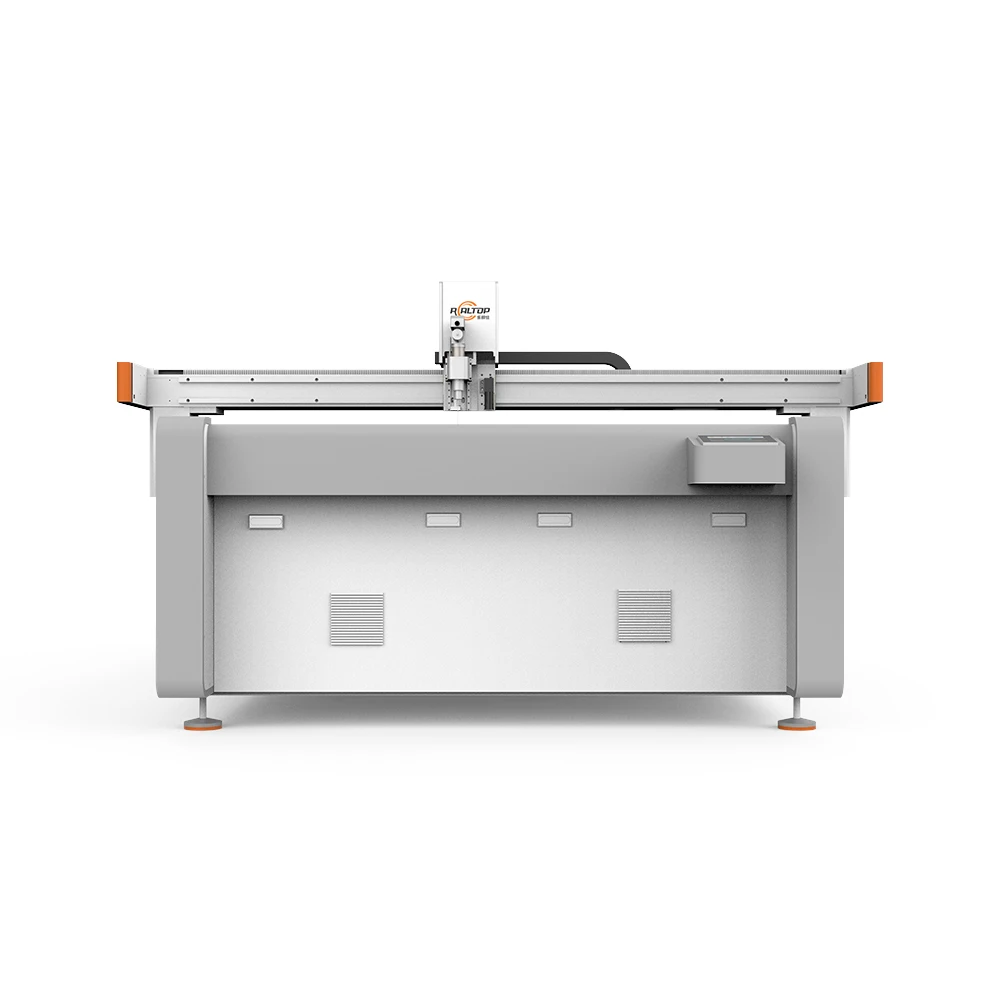
| Product Type | CNC Oscillating Knife Cutting Machine for Packaging |
| Working Area | 1600×2500 mm |
| Cutting Speed | 0–1500 mm/s |
| Cutting Thickness | ≤ 40 mm (basis not stated in source — confirm material type and density) |
| Cutting Accuracy | ±0.1 mm |
| Tool Head Options | Oscillating knife, Driven rotary knife, Creasing wheel, Kiss cutting tool, Pneumatic knife, Milling tool, V groove knife, CCD camera |
| Vacuum Pump | 9 kW |
| Vacuum Table | Aluminum bellows vacuum table with full-surface adsorption |
| Voltage Options | 110V / 220V / 380V (frequency to be confirmed) |
| Control System | PLC control panel with intuitive interface |
| Servo Drive Options | Panasonic, Delta, Dorna (source value — verify against manufacturer catalog) |
| Machine Frame | Heavy-duty frame with precision-ground surface |
| Overall Dimensions (L×W×H) | 3300×2100×1350 mm |
| Safety Devices | Infrared sensor device and emergency stop device |
| Software & File Formats | PLT, DXF, AI, PDF; dedicated packaging box structure design software included |
| Language Options | English, Russian, Italian, Chinese; special languages customizable |
| Key Features | CCD camera contour recognition, multi-zone vacuum hold-down, CE declaration applicable |
Application Suitability
| Application | Material or Output |
|---|---|
| Carton sample making and short-run box prototyping | Corrugated cardboard E-flute, B-flute, BC-flute; greyboard; cardstock; art paper |
| Protective packaging insert fabrication | EVA, EPE, PU foam cut to nested cavity profiles |
| Plastic packaging component cutting | Coroplast, thin PVC and PET sheet |
| Luxury packaging lining and accessories | Velvet, fleece, non-woven fabric, leather and synthetic leather |
| Gasket and composite inlay for rigid boxes | Rubber mats, adhesive-backed composite sheets |
Why the Flute Type You Actually Run Changes the Entire Machine Spec
A CNC cardboard cutting machine manufacturer must know your board construction before quoting a configuration, not after the crate arrives.
I once watched a packaging converter uncrate a flatbed cutter that ran beautifully on single-face E-flute samples — then choked on the BC-flute double-wall stock that made up most of their daily work. The oscillating knife stalled mid-sheet, the vacuum table lost grip on the warped surface, and the CCD camera could not read registration marks through the heavy liner. Five days of on-site tuning followed, and the shop still had to reorder a heavier-duty tool head. [NEED_CITE: corrugated flute classification and thickness ranges]
Knife, Crease and Kiss-Cut on One Table
Switching between cutting, creasing and kiss-cutting on the same 1600×2500 mm bed eliminates the need for separate die-making on short runs. The creasing wheel scores fold lines on greyboard and art paper without fracturing the outer ply, while the oscillating knife handles full-depth cuts through multi-layer corrugated. Kiss-cut tooling stops precisely at the liner, leaving the backing intact for adhesive-backed packaging inserts. This CNC cardboard cutting machine manufacturer approach means a sample room can produce a complete box structure — cut, crease and perforate — in one pass.
CCD Registration on Pre-Printed Carton Stock
Printed carton requires the knife path to track the graphic, not just the file geometry. The CCD camera option reads registration marks on pre-printed corrugated or cardstock and shifts the cut path in real time, compensating for sheet distortion introduced during the printing and lamination stages. On short-run promotional packaging where every sheet carries a different SKU, contour recognition removes the manual alignment step and keeps edge-to-print tolerance within the ±0.1 mm accuracy band. [NEED_CITE: digital die-cutting registration methods for printed packaging]
Vacuum Zoning, Servo Choice and Frame Rigidity
Full-surface aluminum bellows vacuum hold-down addresses the small-part lift problem that plagues nested packaging layouts — think gasket inlays and foam insert cavities where a released piece can drift into the knife path. The 9 kW vacuum pump generates enough suction to pin lightweight cardstock as well as porous corrugated, though zoning configuration should match your typical nest pattern. Servo drive selection across Panasonic, Delta or Dorna options influences acceleration behavior on dense board; heavier BC-flute stock benefits from the higher torque curves available in the upper-range servo option. The heavy-duty frame with precision-ground surface keeps the gantry tracking true across the full 3300 mm length, preventing cumulative drift that would otherwise widen the tolerance band on long cut runs.
What Happens When the Tool Head Does Not Fit the Board
A drag knife forced through double-wall corrugated leaves crushed flutes and ragged liner edges that fail compression tests. A creasing wheel set for greyboard will barely mark EVA foam, leaving fold lines that crack when the insert is pressed into the box. Wrong vacuum zoning lets small Coroplast pieces lift into the knife, chipping the blade and halting the run. These are not edge cases — they are the everyday consequence of specifying a machine by working area alone without mapping tool heads to the actual material stack. [NEED_CITE: tooling selection guidelines for oscillating knife cutting of packaging materials]
Why Source This Configuration Here
In-house design covers both knife and creasing tool heads, so the CNC cardboard cutting machine manufacturer can match the cutting method to your board rather than forcing a single blade through every material. Tool head and vacuum table zoning are specified per your material list and production volume before the build starts. CCD camera positioning is validated on your printed stock, not assumed from a generic test sheet. Software compatibility — including your existing PLT, DXF, AI or PDF nesting workflow — is confirmed before the order is locked. Voltage, control language and documentation are aligned to your local supply and operator requirements, reducing commissioning friction on arrival.
Documentation & Verification
- Machine specification sheet listing every tool head and vacuum zone mapped to your material stack
- Sample cutting report on your corrugated flute type and foam density before order commitment
- Electrical schematic and voltage confirmation matched to your facility supply and frequency
- Software licence and file format compatibility note verified against your nesting workflow
- Factory test record showing cut accuracy on your board ply count before dispatch
- Operation and maintenance manual with spare parts list in your operator language
Installation, Commissioning & Support
- Confirm floor loading for the 3300×2100 mm footprint and allow clearance for sheet feeding on the long axis
- Provide a dedicated circuit matching the selected voltage option and the 9 kW vacuum pump draw
- Machine ships partially disassembled; gantry and vacuum table are leveled and bolted on site
- First-run calibration includes vacuum zone mapping and CCD registration tuning on your stock
- Operator training covers tool head changeover, creasing wheel pressure and software nesting setup
- Spare oscillating knife blades and creasing wheels ship with the machine for initial production runs
Before You Send an Inquiry
Share your most common board flute types, sheet sizes and daily sample volume so the configuration can be scoped accurately. Confirm your local voltage and frequency, the control language your operators need, and whether you require CCD contour recognition for pre-printed work. If your packaging structure design software uses a proprietary format, send a sample file so import compatibility is verified before quotation.
Frequently Asked Questions
Q: How do I choose the right tool head for my corrugated flute type and ply count?
A: E-flute and B-flute single-face boards typically cut cleanly with the standard oscillating knife, while BC-flute double-wall stock may need the pneumatic knife for sufficient stroke. Creasing wheels are selected by wheel width to match the fold-line depth your box structure requires. Send a material sample so the CNC cardboard cutting machine manufacturer can confirm the tool head match before the build.
Q: Will the CCD camera track registration marks at full production speed?
A: The camera reads printed marks and adjusts the cut path in real time, but recognition reliability depends on mark contrast, print quality and sheet flatness. Pre-printed corrugated with high-contrast marks on a stable liner performs well. Low-contrast or heavily textured stocks may require a camera tuning pass during commissioning.
Q: Is the vacuum table adequate for small packaging components in nested layouts?
A: The aluminum bellows table provides full-surface adsorption, which helps hold small pieces like gasket inlays and foam insert cavities. If your nest pattern contains many sub-50 mm parts, requesting a multi-zone vacuum layout lets you activate only the zones under active cutting, maintaining suction density.
Q: Can the software import my existing packaging structure design files?
A: The included software accepts PLT, DXF, AI and PDF formats, covering most mainstream packaging CAD outputs. If your current design tool exports in a proprietary format, provide a sample file before order so import compatibility and nesting workflow integration can be verified.
Q: How should I choose the working area based on my sheet sizes?
A: The 1600×2500 mm bed accommodates most standard packaging sheet sizes. If you regularly run oversized board or need to nest multiple box structures per sheet for yield optimization, discuss larger format options. Match the bed size to both your maximum sheet and your typical daily sample count.
Tool-Head Match per Material — every knife, creasing wheel and kiss-cut tool on this table is specified against your flute type and ply count before the order goes to the factory floor.
Technical Specifications
| Parameter | Value |
|---|---|
| Product Type | CNC Oscillating Knife Cutting Machine for Packaging |
| Working Area | 1600×2500 mm |
| Cutting Speed | 0–1500 mm/s |
| Cutting Thickness | ≤ 40 mm (basis not stated in source — confirm material type and density) |
| Cutting Accuracy | ±0.1 mm |
| Tool Head Options | Oscillating knife, Driven rotary knife, Creasing wheel, Kiss cutting tool, Pneumatic knife, Milling tool, V groove knife, CCD camera |
| Vacuum Pump | 9 kW |
| Vacuum Table | Aluminum bellows vacuum table with full-surface adsorption |
| Voltage Options | 110V / 220V / 380V (frequency to be confirmed) |
| Control System | PLC control panel with intuitive interface |
| Servo Drive Options | Panasonic, Delta, Dorna (source value — verify against manufacturer catalog) |
| Machine Frame | Heavy-duty frame with precision-ground surface |
| Overall Dimensions (L×W×H) | 3300×2100×1350 mm |
| Safety Devices | Infrared sensor device and emergency stop device |
| Software & File Formats | PLT, DXF, AI, PDF; dedicated packaging box structure design software included |
| Language Options | English, Russian, Italian, Chinese; special languages customizable |
| Key Features | CCD camera contour recognition, multi-zone vacuum hold-down, CE declaration applicable |
Application Suitability
| Application | Material or Output |
|---|---|
| Carton sample making and short-run box prototyping | Corrugated cardboard E-flute, B-flute, BC-flute; greyboard; cardstock; art paper |
| Protective packaging insert fabrication | EVA, EPE, PU foam cut to nested cavity profiles |
| Plastic packaging component cutting | Coroplast, thin PVC and PET sheet |
| Luxury packaging lining and accessories | Velvet, fleece, non-woven fabric, leather and synthetic leather |
| Gasket and composite inlay for rigid boxes | Rubber mats, adhesive-backed composite sheets |
Why the Flute Type You Actually Run Changes the Entire Machine Spec
A CNC cardboard cutting machine manufacturer must know your board construction before quoting a configuration, not after the crate arrives.
I once watched a packaging converter uncrate a flatbed cutter that ran beautifully on single-face E-flute samples — then choked on the BC-flute double-wall stock that made up most of their daily work. The oscillating knife stalled mid-sheet, the vacuum table lost grip on the warped surface, and the CCD camera could not read registration marks through the heavy liner. Five days of on-site tuning followed, and the shop still had to reorder a heavier-duty tool head. [NEED_CITE: corrugated flute classification and thickness ranges]
Knife, Crease and Kiss-Cut on One Table
Switching between cutting, creasing and kiss-cutting on the same 1600×2500 mm bed eliminates the need for separate die-making on short runs. The creasing wheel scores fold lines on greyboard and art paper without fracturing the outer ply, while the oscillating knife handles full-depth cuts through multi-layer corrugated. Kiss-cut tooling stops precisely at the liner, leaving the backing intact for adhesive-backed packaging inserts. This CNC cardboard cutting machine manufacturer approach means a sample room can produce a complete box structure — cut, crease and perforate — in one pass.
CCD Registration on Pre-Printed Carton Stock
Printed carton requires the knife path to track the graphic, not just the file geometry. The CCD camera option reads registration marks on pre-printed corrugated or cardstock and shifts the cut path in real time, compensating for sheet distortion introduced during the printing and lamination stages. On short-run promotional packaging where every sheet carries a different SKU, contour recognition removes the manual alignment step and keeps edge-to-print tolerance within the ±0.1 mm accuracy band. [NEED_CITE: digital die-cutting registration methods for printed packaging]
Vacuum Zoning, Servo Choice and Frame Rigidity
Full-surface aluminum bellows vacuum hold-down addresses the small-part lift problem that plagues nested packaging layouts — think gasket inlays and foam insert cavities where a released piece can drift into the knife path. The 9 kW vacuum pump generates enough suction to pin lightweight cardstock as well as porous corrugated, though zoning configuration should match your typical nest pattern. Servo drive selection across Panasonic, Delta or Dorna options influences acceleration behavior on dense board; heavier BC-flute stock benefits from the higher torque curves available in the upper-range servo option. The heavy-duty frame with precision-ground surface keeps the gantry tracking true across the full 3300 mm length, preventing cumulative drift that would otherwise widen the tolerance band on long cut runs.
What Happens When the Tool Head Does Not Fit the Board
A drag knife forced through double-wall corrugated leaves crushed flutes and ragged liner edges that fail compression tests. A creasing wheel set for greyboard will barely mark EVA foam, leaving fold lines that crack when the insert is pressed into the box. Wrong vacuum zoning lets small Coroplast pieces lift into the knife, chipping the blade and halting the run. These are not edge cases — they are the everyday consequence of specifying a machine by working area alone without mapping tool heads to the actual material stack. [NEED_CITE: tooling selection guidelines for oscillating knife cutting of packaging materials]
Why Source This Configuration Here
In-house design covers both knife and creasing tool heads, so the CNC cardboard cutting machine manufacturer can match the cutting method to your board rather than forcing a single blade through every material. Tool head and vacuum table zoning are specified per your material list and production volume before the build starts. CCD camera positioning is validated on your printed stock, not assumed from a generic test sheet. Software compatibility — including your existing PLT, DXF, AI or PDF nesting workflow — is confirmed before the order is locked. Voltage, control language and documentation are aligned to your local supply and operator requirements, reducing commissioning friction on arrival.
Documentation & Verification
- Machine specification sheet listing every tool head and vacuum zone mapped to your material stack
- Sample cutting report on your corrugated flute type and foam density before order commitment
- Electrical schematic and voltage confirmation matched to your facility supply and frequency
- Software licence and file format compatibility note verified against your nesting workflow
- Factory test record showing cut accuracy on your board ply count before dispatch
- Operation and maintenance manual with spare parts list in your operator language
Installation, Commissioning & Support
- Confirm floor loading for the 3300×2100 mm footprint and allow clearance for sheet feeding on the long axis
- Provide a dedicated circuit matching the selected voltage option and the 9 kW vacuum pump draw
- Machine ships partially disassembled; gantry and vacuum table are leveled and bolted on site
- First-run calibration includes vacuum zone mapping and CCD registration tuning on your stock
- Operator training covers tool head changeover, creasing wheel pressure and software nesting setup
- Spare oscillating knife blades and creasing wheels ship with the machine for initial production runs
Before You Send an Inquiry
Share your most common board flute types, sheet sizes and daily sample volume so the configuration can be scoped accurately. Confirm your local voltage and frequency, the control language your operators need, and whether you require CCD contour recognition for pre-printed work. If your packaging structure design software uses a proprietary format, send a sample file so import compatibility is verified before quotation.
Frequently Asked Questions
Q: How do I choose the right tool head for my corrugated flute type and ply count?
A: E-flute and B-flute single-face boards typically cut cleanly with the standard oscillating knife, while BC-flute double-wall stock may need the pneumatic knife for sufficient stroke. Creasing wheels are selected by wheel width to match the fold-line depth your box structure requires. Send a material sample so the CNC cardboard cutting machine manufacturer can confirm the tool head match before the build.
Q: Will the CCD camera track registration marks at full production speed?
A: The camera reads printed marks and adjusts the cut path in real time, but recognition reliability depends on mark contrast, print quality and sheet flatness. Pre-printed corrugated with high-contrast marks on a stable liner performs well. Low-contrast or heavily textured stocks may require a camera tuning pass during commissioning.
Q: Is the vacuum table adequate for small packaging components in nested layouts?
A: The aluminum bellows table provides full-surface adsorption, which helps hold small pieces like gasket inlays and foam insert cavities. If your nest pattern contains many sub-50 mm parts, requesting a multi-zone vacuum layout lets you activate only the zones under active cutting, maintaining suction density.
Q: Can the software import my existing packaging structure design files?
A: The included software accepts PLT, DXF, AI and PDF formats, covering most mainstream packaging CAD outputs. If your current design tool exports in a proprietary format, provide a sample file before order so import compatibility and nesting workflow integration can be verified.
Q: How should I choose the working area based on my sheet sizes?
A: The 1600×2500 mm bed accommodates most standard packaging sheet sizes. If you regularly run oversized board or need to nest multiple box structures per sheet for yield optimization, discuss larger format options. Match the bed size to both your maximum sheet and your typical daily sample count.










商品评价
There are no reviews yet.