


Fast Delivery
Quick, reliable shipping to any location.

Free & easy returns
Return this item by mail or in store within 90 days for a full refund.
Complete Machine Families — We design oscillating knife, drag knife, and flatbed digital cutting tables under one roof, letting you match the cutting method to your corrugated board grade rather than force a single setup.
Technical Specifications
| Parameter | Value |
|---|---|
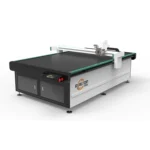
| Product Type | CNC Oscillating Knife Cutting Machine |
| Working Area | 1600 mm × 2500 mm |
| Overall Dimensions | 3450 mm × 2300 mm × 1250 mm |
| Rated Power | 6.6 kW |
| Vacuum Pump Power | 7.5 kW |
| Voltage | 380V ±10% (frequency to be confirmed for target market) |
| Tool Head Type | Oscillating knife (Swiss imported blade) with full cutting, half cutting, and cursor location |
| Translational Velocity | 800–1200 mm/s |
| Cutting Thickness | 20–80 mm (basis not stated in source — confirm block format / material) |
| Repeatability | ≤ 0.1 mm |
| Transmission System | Digital servo motor, linear guide, synchronous belt, ball screw (Taiwan Hiwin rail) |
| Servo Motor | Taiwan Delta servo motors and drivers |
| Vacuum Table | Aluminum alloy honeycomb structure, vacuum partition adsorption with zone control |
| Safety Device | Infrared sensors and emergency stop |
| Conveyor Belt | Germany imported felt belt (composite fiber, tension strength increased by 35%) |
| Software | Professional carton nesting software included, supports PLT / DXF, HP-GL compatible |
| Language Options | English, Russian, Italian, Chinese (custom languages available) |
| Key Features | Auto feeding available, CCD camera positioning available, CE referenced |
Application Suitability
| Application | Material or Output |
|---|---|
| Corrugated carton and packaging sample making | Single, double, and triple-wall corrugated cardboard, greyboard |
| Sticker and label contour cutting | Vinyl, self-adhesive film, reflective sheeting |
| Flexible garment and leather goods cutting | Woven fabric, non-woven textile, genuine and synthetic leather |
| Composite and soft material processing | Sponge composite leather, PVC, soft glass, silicon, rubber |
| Signage and display production | Coroplast, foam board, honeycomb paper, business card stock |
Why Cutting Thickness Claims Fail on the Shop Floor
A flatbed digital cutting table specified by working area alone often fails when it meets the actual material thickness in production. The motor torque and stroke frequency behind the oscillating knife head determine what you can actually cut, not just the Z-axis travel.
I once saw a packaging shop buy a machine based on a sample cut through 200g coated paper, only to find the blade crushed the edges of their 3mm greyboard and the motor stalled. The translational velocity dropped to a crawl, and the blade wore out in hours. We had to retrofit a higher-frequency oscillating head and uprate the drive motor before the line ran properly. Always ask the CNC Oscillating Knife Cutting Machine manufacturer to test your exact board grade and flute profile before you sign. [NEED_CITE: relationship between oscillation frequency and material density in digital cutting]
Matching the Tool Head to Corrugated Grades
Different flute profiles and board densities demand different knife actions. A standard drag knife pulls through thin card cleanly but drags and delaminates the liner on double-wall corrugated. The oscillating knife head on this CNC Oscillating Knife Cutting Machine vibrates at high frequency to slice through the flutes without crushing them, preserving the structural integrity of the carton wall. Half-cutting mode scores the crease lines without cutting through, which is essential for folding carton sample work.
Vacuum Zoning for Small Parts and Nesting Yield
Holding small cut pieces flat on the table is one of the hardest challenges in carton sample making. A single-zone vacuum bed loses suction once the knife cuts through the material, letting small parts lift and shift. The aluminum alloy honeycomb table on this machine uses vacuum partition adsorption, meaning the bed is divided into independent zones. You activate only the zones under your nested layout, maintaining holding force even on narrow offcuts and label shapes.
Delta Servos and Hiwin Rails in Daily Production
Repeatability of ≤ 0.1 mm is not just a brochure number — it is what keeps your crease lines aligned with your cut lines on a carton blank. The Taiwan Delta servo motors and drivers close the position loop at high frequency, while the Hiwin linear guides carry the gantry without play. When you are running a batch of fifty sample boxes and every crease has to land within a fraction of a millimeter of the cut edge, this combination of drive and guidance keeps the geometry consistent from the first piece to the last. [NEED_CITE: alignment tolerance requirements in carton sample making workflows]
Reading the Specs That Actually Matter
The 800–1200 mm/s translational velocity range tells you how fast the head moves between cuts, but actual throughput depends on how many direction changes your nesting layout requires. The cutting thickness range of 20–80 mm is stated without a material basis, so you must verify it against your specific board grade and flute profile before ordering. The 7.5 kW vacuum pump is sized to pull sufficient air through the honeycomb table to hold corrugated sheets flat; undersized pumps lose grip on porous materials. The included carton nesting software accepts PLT and DXF files, which means your existing design files should import directly, but always confirm your specific nesting workflow before commitment.
The Hidden Cost of a Wrong Configuration
Choosing the wrong tool head for your material produces ragged edges on corrugated board and crushed foam on packaging inserts. When the vacuum zoning is not matched to your part sizes, small carton blanks lift during cutting and the piece is scrapped. If the voltage and frequency are not confirmed for your market before shipment, the servo drives can fault on startup, delaying your installation by weeks. These are not theoretical risks — I have seen each one on a customer’s floor. [NEED_CITE: common causes of edge quality failure in oscillating knife cutting]
Why Buyers Source This Range Here
The same factory designs both knife cutting and laser cutting systems, so you get an honest recommendation on which method suits your material rather than a push toward whichever machine is in stock. Every oscillating knife and drag knife configuration is specified against your actual material type, thickness, and daily volume before an order is placed. CCD camera positioning for printed contour work is available as an option, not an afterthought. Software compatibility with your existing PLT or DXF workflow is confirmed before production starts. You can send your own corrugated board or label stock for sample cutting and evaluate edge quality before you commit to the purchase.
Documentation & Verification
- Machine specification sheet listing every tool head and table zone configured for your board grade
- Electrical schematic with voltage, frequency, and plug type confirmed for your destination market
- Sample cutting report on your corrugated board showing edge quality and crease alignment
- Software licence file with nesting module activated and PLT / DXF import tested
- Factory test record capturing repeatability measurements across the full 1600 × 2500 mm travel
- Spare parts list covering Swiss blades, felt belt segments, and vacuum zone seals
Installation, Commissioning & Support
- Floor space must accommodate 3450 mm × 2300 mm footprint plus operator access on three sides
- Dedicated 380V ±10% circuit required with separate breaker for the 7.5 kW vacuum pump
- Machine ships in a single crate; the honeycomb table and gantry are aligned at the factory and re-verified on site
- First-run commissioning includes vacuum zone mapping and servo tuning on your actual corrugated stock
- Operator training covers nesting software workflow, blade change procedure, and HP-GL file import
- Preventive maintenance schedule covers Hiwin rail lubrication and felt belt tension checks at defined intervals
What to Include in Your Inquiry
Tell us your primary material type, board grade, and maximum sheet thickness so we can recommend the correct oscillating knife frequency and vacuum zone layout. Confirm your local voltage and frequency, and let us know if your design team works in PLT, DXF, or another file format. If you have a specific carton blank or label contour you want tested, send us a sample drawing and the actual material — we will run it on the machine and send you the cut pieces and a report before you decide.
Frequently Asked Questions
Q: How do I choose between oscillating knife and drag knife for my material?
A: Drag knives work well on thin, uniform materials like vinyl and cardstock where a pulled cut produces a clean edge. Oscillating knives are necessary for thicker or layered materials like corrugated board, foam, and composite leather, where the vibrating action slices through without crushing the flutes or delaminating the layers. We recommend testing both on your actual material before finalizing the configuration.
Q: What working area sizes are available across the catalogue?
A: This model covers a 1600 × 2500 mm working area, which handles most standard packaging sample and carton blank sizes. Other models in the range cover both more compact tables for label and sticker work and larger-format beds for full-sheet corrugated processing. We match the bed size to your maximum sheet dimension and nesting volume.
Q: How is cutting thickness verified before I commit?
A: The stated 20–80 mm range is based on conditions not specified in the source data. We verify actual cutting capacity by running your specific material — your board grade, flute profile, and thickness — on the machine before you place the order. The sample cutting report documents edge quality, crease depth, and cycle time on your actual stock.
Q: Can the machine import my existing design files?
A: The included software supports PLT and DXF file formats and the HP-GL instruction system. Before your order, we ask you to send your typical nesting files so we can test import, verify layer recognition, and confirm that crease lines and cut lines are assigned correctly. If your workflow uses a proprietary format, we confirm compatibility before production.
Q: What voltage and language options can I specify?
A: The standard electrical supply is 380V ±10%, with frequency to be confirmed for your destination market. Control language options include English, Russian, Italian, and Chinese, with custom languages available. We confirm voltage, plug type, frequency, and interface language in writing before the machine enters production.










商品评价
There are no reviews yet.